

Your finances should be working for you. Most of the time, they aren't.
Not because of bad accounting. Not because of bad advisors. Because the model most businesses are running on was built for a completely different purpose — and nobody ever told you that. We built something different. This is how it works and why it works.The model most businesses run on was built for auditors.
Not entrepreneurs.
The traditional financial model — bookkeeper handles the records, accountant closes the year, tax gets filed, everyone moves on — was designed to satisfy one requirement. Compliance. It was built for regulators, filings, and auditors who need to verify what happened after the fact. It does exactly the job it was designed to do.
The problem is it was never designed for you.
You are not an auditor. You are an entrepreneur making real decisions with real stakes in real time. You need to know if the hire you are considering is financially viable right now. You need to know if the equipment purchase should happen before or after your fiscal year. You need to know what your tax position looks like in August — not April. You need someone watching your numbers who will pick up the phone and tell you something important before the window closes — not after.
The compliance model was not built to do that. Not because the people in it are not good. Because it was designed for a different job entirely. And so what happens instead is this: your books get done, your return gets filed, and somewhere in the gap between those two events — in all the decisions made without a complete picture, all the planning conversations that never happened, all the windows that closed before anyone noticed — the real cost accumulates. Quietly. Invisibly. Year after year.
We call this Financial Fragmentation. And it shows up the same way in almost every business we meet at your stage.
Unstable financial data
Books behind. Numbers you do not fully trust. Reports arriving too late to act on. Decisions made on a picture that is 60 to 90 days stale.
Unreliable oversight
Year-end focused. Slow to respond. Tax conversations that happen after meaningful windows have already closed. Compliance current, planning not.
No financial direction
Growing revenue without a clear financial north star. Major decisions without measurable targets. Nobody accountable to where the business is actually going.
We got tired of watching good businesses get quietly let down.
After nearly two decades working with thousands of North American entrepreneurs, we kept seeing the same pattern. Talented, capable operators — people who had built real businesses through real work — being consistently underserved by a model that was never designed for what they actually needed.
The books may be reconciled. The returns may be filed. The advice may be sound. And yet the business owner was still the one connecting the dots, still being surprised in April, still making major decisions without a complete picture, still wondering why a business doing their revenue felt financially uncertain on the inside. It was not a talent problem. It was not a people problem. It was a model problem.
So we decided to leave the old model behind and built a new one entirely. We called it the Entrepreneur Financial Operating System. And the principle it runs on — the reason it produces fundamentally different outcomes — is what we call Financial Enablement. Here is what that means.
Finance should enable your business. Not just report on it.
That sounds obvious when you say it out loud. But it is not how most businesses experience it.
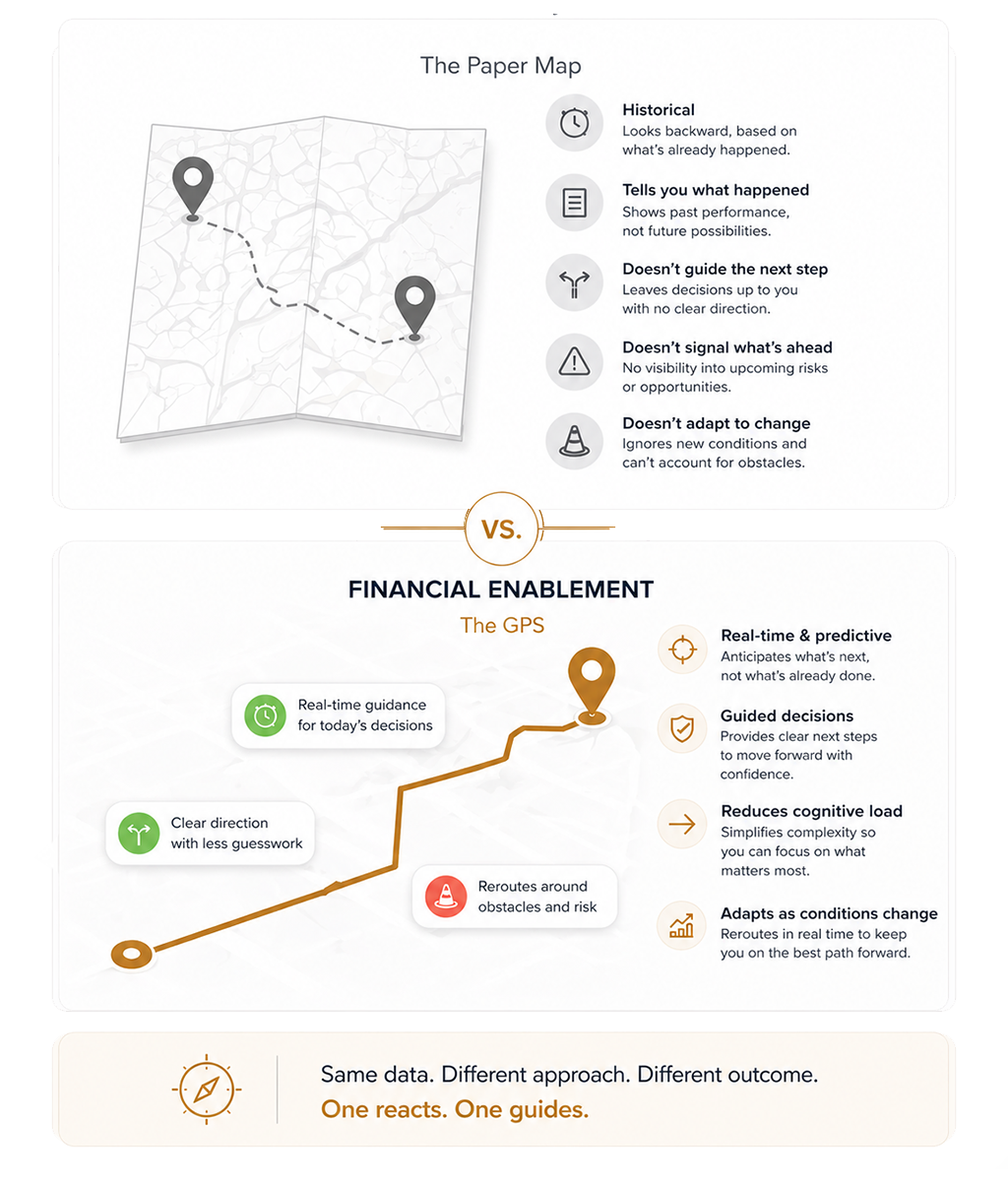
Financial Enablement is the idea that your financial setup should be actively working for you — surfacing opportunities before they close, protecting your position before risks compound, guiding your decisions before they get made. It is the difference between GPS and a paper map. Both contain accurate information. Only one of them tells you what to do next, based on where you are now.
We spent years building toward this idea. What we found is that Financial Enablement is not just a matter of hiring good people or finding a bigger firm. It is structural. It requires three specific conditions to exist simultaneously — and the traditional compliance model creates none of them.
Three principles. One integrated truth.
Financial Enablement is not a philosophy we invented. It is the convergence of three established bodies of research — each one identifying a different reason why fragmented financial setups consistently fail good business owners. Together they explain why an integrated system produces fundamentally different outcomes. Here is what they found.
Most businesses do not have a financial system. They have financial pieces. A bookkeeper on one schedule. An accountant who appears at year-end. A tax conversation that happens when you remember to ask. Each piece is doing its job independently — but nobody designed them to work together.
The result is that every time information needs to move from one part of your financial setup to another, something gets lost. You become the one trying to hold it all together — the unofficial project manager of your own finances.
Right now, the people managing your finances know significantly more about your financial situation than you do — and they know it sooner. Your accountant knows what a review of your remuneration structure would find. Your tax advisor knows which planning windows are closing this year. Your bookkeeper knows what your numbers actually look like right now. You know almost none of this in real time.This is not anyone's fault. It is how the compliance model was built.
Information flows to the advisors who need it to do their job — and arrives at your desk afterward, in a summary format, after the decisions that information could have shaped have already been made. You are consistently operating one step behind your own financial picture.
The quality of a financial decision is not primarily determined by the capability of the person making it. It is determined by the quality of the environment supporting them at the moment they make it. Think about the last time you made a financial decision that felt uncertain — not because you lacked intelligence or experience, but because you did not have a current, clear, interpreted picture to make it from.
That is not a you problem. That is an environment problem. And it is the environment the compliance model consistently creates — one where your financial intelligence is always slightly behind the moment that needs it.
When data, oversight, and direction operate as one system, the business owner stops connecting dots and starts leading from a complete picture.
Without Structural Alignment
You feel like you are managing your financial providers rather than leading your business. You are forwarding emails, chasing answers, trying to figure out if anyone is looking at the whole picture. The honest answer is that nobody is — because the model was never designed for that.
With Structural Alignment
The pieces are gone. In their place is one integrated operating rhythm — data, oversight, and direction designed to feed each other and produce a unified picture. You stop being the connector. You start being the decision-maker. The difference in what that feels like week to week is significant.
The Science Behind Structural Alignment
Systems theory establishes a principle that is simple but profound: a coherent system — one where components share a common operating logic, feed each other's outputs, and work toward a unified objective — produces outcomes that no individual component could generate alone. This is not a marginal improvement. It is structural.
Researchers in organizational systems and coherence theory have consistently found that integration does not just reduce friction — it produces emergent value that disconnected components are structurally incapable of creating. The compliance model is incoherent by design: three components built for three separate purposes with no shared operating model. The EFOS is engineered from the ground up as a coherent system. The output is fundamentally different because the structure is fundamentally different.
A business owner informed in real time makes structurally better decisions — not because they are smarter, but because the information arrived in time to act on it.
Without Informed Advantage
Before Informed Advantage, you do not know what you do not know — which means you cannot ask for it, you cannot act on it, and you cannot benefit from it. You are making decisions with a partial picture and you often do not realize the picture was partial until April, when someone tells you what happened last year. The feeling is reactive. The cost is real.
With Informed Advantage
After Informed Advantage, you are inside the information flow rather than downstream from it. When your tax position shifts, you know. When a planning opportunity opens, you know while there is still time to act. When a legislative change affects your structure, your advisor surfaces it before it becomes a problem. You are no longer the last person in the room to know what is happening in your own business. That shift — from being informed after the fact to being informed in real time — changes not just your outcomes but how you feel about your finances entirely. Confident replaces anxious. Decisive replaces reactive.
The Science Behind Informed Advantage
In 2001, economists George Akerlof, Michael Spence, and Joseph Stiglitz were awarded the Nobel Prize in Economics for their research on information asymmetry — the condition where one party in a relationship has significantly more or better information than the other. Their research established that this imbalance consistently produces worse outcomes for the less-informed party — not because of bad intent, but because of structural disadvantage.
The less-informed party cannot ask the right questions because they do not know what questions to ask. They cannot act on opportunities because they do not know the opportunities exist. They cannot protect themselves from risks because those risks are invisible to them. This dynamic is built into the traditional client-advisor relationship in financial services. The EFOS is designed to eliminate it by keeping the business owner inside the information flow rather than downstream from it — transforming a structural disadvantage into a structural advantage.
The gap between a reactive business owner and a decisive one is rarely capability. It is almost always the readiness of the environment supporting them.
Without Activation Readiness
Before Activation Readiness, you hesitate on decisions you should be confident about. You delay because the picture is not clear enough. You ask for reports and wait. You make calls on feel because the data is not current enough to trust. The business moves forward but it moves forward on instinct more than it should for a business at your stage. The cost is not always visible — it shows up in the decisions you did not make, the opportunities you were not positioned to take, and the time you spent waiting for information that should have already been there.
With Activation Readiness
After Activation Readiness, your financial environment is built around your decision cycle rather than CRA's filing cycle. When you need to know something — when an opportunity appears, when a risk is emerging, when a hire needs to be made — the information is already there, already interpreted, already connected to what it means for your business specifically. You do not wait for clarity. You operate from it. The decisions you make in that environment are not just better informed — they feel different. Confident. Clean. Made from a position of control rather than uncertainty.
The Science Behind Activation Readiness
Organizational psychologists building on Kurt Lewin's foundational field theory established that human performance is not primarily a function of capability — it is a function of the readiness of the environment to support that capability at the right moment. Lewin's work identified that behavior is a product of the person and their environment simultaneously — change the environment and you change the output even when the person remains constant. Subsequent decision science research by Daniel Kahneman and others demonstrated that cognitive load — the mental effort required to translate raw information into actionable understanding — dramatically degrades decision quality under conditions of incomplete, delayed, or uninterpreted information.
The compliance model consistently creates high cognitive load for business owners: information is delayed, arrives in formats requiring translation, and is disconnected from the specific decisions that need to be made. The EFOS is designed to eliminate that cognitive load — delivering interpreted, timely, decision-ready intelligence so that the business owner's full capability can be applied to the decision itself rather than to the work of preparing to make it.
-
Structural Alignment
Most businesses do not have a financial system. They have financial pieces. A bookkeeper on one schedule. An accountant who appears at year-end. A tax conversation that happens when you remember to ask. Each piece is doing its job independently — but nobody designed them to work together.
The result is that every time information needs to move from one part of your financial setup to another, something gets lost. You become the one trying to hold it all together — the unofficial project manager of your own finances.
When data, oversight, and direction operate as one system, the business owner stops connecting dots and starts leading from a complete picture.
Without Structural Alignment
You feel like you are managing your financial providers rather than leading your business. You are forwarding emails, chasing answers, trying to figure out if anyone is looking at the whole picture. The honest answer is that nobody is — because the model was never designed for that.
With Structural Alignment
The pieces are gone. In their place is one integrated operating rhythm — data, oversight, and direction designed to feed each other and produce a unified picture. You stop being the connector. You start being the decision-maker. The difference in what that feels like week to week is significant.
The Science Behind Structural Alignment
Systems theory establishes a principle that is simple but profound: a coherent system — one where components share a common operating logic, feed each other's outputs, and work toward a unified objective — produces outcomes that no individual component could generate alone. This is not a marginal improvement. It is structural.
Researchers in organizational systems and coherence theory have consistently found that integration does not just reduce friction — it produces emergent value that disconnected components are structurally incapable of creating. The compliance model is incoherent by design: three components built for three separate purposes with no shared operating model. The EFOS is engineered from the ground up as a coherent system. The output is fundamentally different because the structure is fundamentally different.
-
Informed Advantage
Right now, the people managing your finances know significantly more about your financial situation than you do — and they know it sooner. Your accountant knows what a review of your remuneration structure would find. Your tax advisor knows which planning windows are closing this year. Your bookkeeper knows what your numbers actually look like right now. You know almost none of this in real time.This is not anyone's fault. It is how the compliance model was built.
Information flows to the advisors who need it to do their job — and arrives at your desk afterward, in a summary format, after the decisions that information could have shaped have already been made. You are consistently operating one step behind your own financial picture.A business owner informed in real time makes structurally better decisions — not because they are smarter, but because the information arrived in time to act on it.
Without Informed Advantage
Before Informed Advantage, you do not know what you do not know — which means you cannot ask for it, you cannot act on it, and you cannot benefit from it. You are making decisions with a partial picture and you often do not realize the picture was partial until April, when someone tells you what happened last year. The feeling is reactive. The cost is real.
With Informed Advantage
After Informed Advantage, you are inside the information flow rather than downstream from it. When your tax position shifts, you know. When a planning opportunity opens, you know while there is still time to act. When a legislative change affects your structure, your advisor surfaces it before it becomes a problem. You are no longer the last person in the room to know what is happening in your own business. That shift — from being informed after the fact to being informed in real time — changes not just your outcomes but how you feel about your finances entirely. Confident replaces anxious. Decisive replaces reactive.
The Science Behind Informed Advantage
In 2001, economists George Akerlof, Michael Spence, and Joseph Stiglitz were awarded the Nobel Prize in Economics for their research on information asymmetry — the condition where one party in a relationship has significantly more or better information than the other. Their research established that this imbalance consistently produces worse outcomes for the less-informed party — not because of bad intent, but because of structural disadvantage.
The less-informed party cannot ask the right questions because they do not know what questions to ask. They cannot act on opportunities because they do not know the opportunities exist. They cannot protect themselves from risks because those risks are invisible to them. This dynamic is built into the traditional client-advisor relationship in financial services. The EFOS is designed to eliminate it by keeping the business owner inside the information flow rather than downstream from it — transforming a structural disadvantage into a structural advantage.
-
Activation Readiness
The quality of a financial decision is not primarily determined by the capability of the person making it. It is determined by the quality of the environment supporting them at the moment they make it. Think about the last time you made a financial decision that felt uncertain — not because you lacked intelligence or experience, but because you did not have a current, clear, interpreted picture to make it from.
That is not a you problem. That is an environment problem. And it is the environment the compliance model consistently creates — one where your financial intelligence is always slightly behind the moment that needs it.The gap between a reactive business owner and a decisive one is rarely capability. It is almost always the readiness of the environment supporting them.
Without Activation Readiness
Before Activation Readiness, you hesitate on decisions you should be confident about. You delay because the picture is not clear enough. You ask for reports and wait. You make calls on feel because the data is not current enough to trust. The business moves forward but it moves forward on instinct more than it should for a business at your stage. The cost is not always visible — it shows up in the decisions you did not make, the opportunities you were not positioned to take, and the time you spent waiting for information that should have already been there.
With Activation Readiness
After Activation Readiness, your financial environment is built around your decision cycle rather than CRA's filing cycle. When you need to know something — when an opportunity appears, when a risk is emerging, when a hire needs to be made — the information is already there, already interpreted, already connected to what it means for your business specifically. You do not wait for clarity. You operate from it. The decisions you make in that environment are not just better informed — they feel different. Confident. Clean. Made from a position of control rather than uncertainty.
The Science Behind Activation Readiness
Organizational psychologists building on Kurt Lewin's foundational field theory established that human performance is not primarily a function of capability — it is a function of the readiness of the environment to support that capability at the right moment. Lewin's work identified that behavior is a product of the person and their environment simultaneously — change the environment and you change the output even when the person remains constant. Subsequent decision science research by Daniel Kahneman and others demonstrated that cognitive load — the mental effort required to translate raw information into actionable understanding — dramatically degrades decision quality under conditions of incomplete, delayed, or uninterpreted information.
The compliance model consistently creates high cognitive load for business owners: information is delayed, arrives in formats requiring translation, and is disconnected from the specific decisions that need to be made. The EFOS is designed to eliminate that cognitive load — delivering interpreted, timely, decision-ready intelligence so that the business owner's full capability can be applied to the decision itself rather than to the work of preparing to make it.
The Entrepreneur Financial Operating System
The EFOS is how we deliver Financial Enablement. It is an integrated operating model — three engines engineered to work together, each one solving one of the three root problems of Financial Fragmentation, each one powered by the three principles above. Every engine feeds the next. Clean data makes real tax planning possible. Protected tax creates the margin for strategic growth. Strategic direction gives clean data its purpose. The loop is what makes it a system rather than a menu. And the system is what makes Financial Enablement possible.
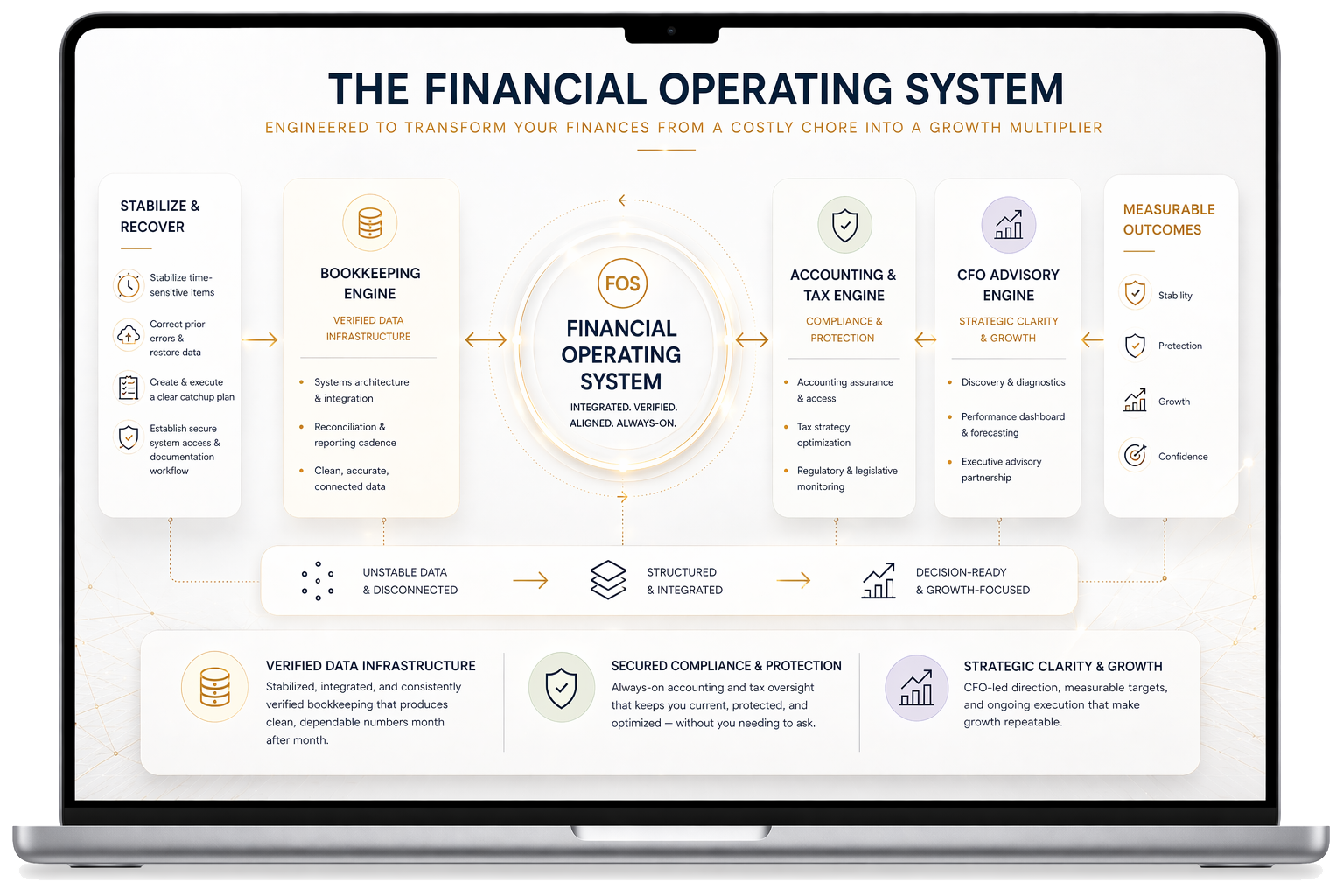
Stabilized, integrated, and consistently verified bookkeeping that produces clean, dependable numbers month after month. Because everything else in the system depends on it — and you cannot plan from data you do not trust.



This is not an upgrade to your current model.
It is a different model entirely.
Financial Enablement and the compliance model are not two points on the same spectrum. They are two fundamentally different operating philosophies — built for different purposes, producing different outcomes, and creating entirely different experiences for the business owner inside them.
Reactive. Fragmented. Lagging.
The Compliance Model
Proactive. Integrated. Enabled.
The Financial Enablement Model
Built for operators who have outgrown the model that got them here.
The EFOS is for North American business owners generating $1M+ — operators who have built something real and are now making decisions that carry real financial weight. If any of these sounds like your life right now, you are exactly who we built this for.
- You are growing revenue but the financial foundation feels like it is straining under the weight of that growth.
- Your tax conversation happens at year-end and you suspect there are decisions you could be making throughout the year that would meaningfully change what you owe.
- You have a bookkeeper, an accountant, and maybe a tax person — and you are the one connecting all the dots between them.
- You are making major decisions — hiring, expanding, taking on debt — without a financial picture you fully trust.
- You do not have a defined financial north star — a specific measurable target that every financial decision is working toward.
- You feel financially successful from the outside and financially uncertain on the inside — and you know that gap is a system problem, not a you problem.
We did not adopt this model. We engineered it.
Over nearly two decades working exclusively with North American small business owners, we kept seeing the same thing. Talented, capable operators being quietly failed not by their own decisions but by a model designed for a different era and a different purpose. We kept asking the same question: what would a financial system actually built for an entrepreneur look like?
The EFOS is our answer. Not a repackaging of traditional accounting services. A ground-up rethinking of how financial management, tax oversight, and strategic direction should operate — as one integrated system, guided by a principle we call Financial Enablement.
Ready to find out where your setup actually stands?
Take our free 3-minute Financial Assessment and receive a personalized score showing exactly where your biggest gaps are —
and what they are likely costing your business right now.
